Insights & News
TECH 21 NYC
TECH 21 NYC
OFFICIAL BLOG
Discover tone secrets, SansAmp technical guides, artist setups, and industry news from the pioneers of analog amp emulation.


A MIDI Foot Controller can turn a crowded stage into a more manageable workspace. A performer can change presets, trigger backing tracks, or control effects without reaching for a laptop. Yet choosing one is not just a matter of counting switches. Compatibility, expression inputs, MIDI routing, build quality, and dependable support all affect how a unit performs during rehearsal and live use.
The market context is broader than foot controllers alone. Grand View Research’s Global Musical Instruments Market report valued that market at USD 17.03 billion in 2023 and projected growth through 2030. This figure covers many instrument categories, not MIDI foot controllers specifically, so it should not be read as a sales estimate for this niche. The MIDI Association’s standards resources provide a complementary technical reference, including documentation on MIDI 1.0 and MIDI 2.0. Together, these sources help frame both demand for music equipment and the communication standards manufacturers must consider.
This guide compares ten China-based manufacturers through practical questions: What connections do their controllers offer? Can users assign commands without complicated setup? Are product specifications, firmware details, and after-sales channels easy to verify? Small details matter. A clearly labeled jack can save time when a pedalboard is already packed. Company listings and product ranges may change, too; this comparison is a starting point, not a substitute for checking current specifications, samples, and supplier support. Some differences are easy to measure. Others become clear only underfoot.
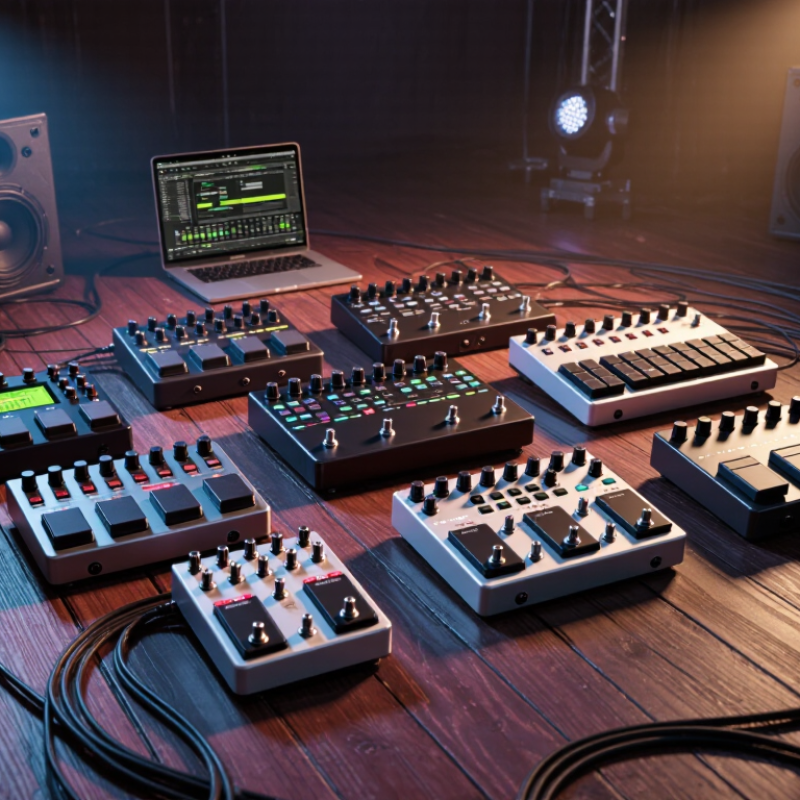
A MIDI foot controller is a floor-operated device that sends MIDI commands to compatible instruments, processors, or software. It usually does not create sound itself. Instead, its switches and expression inputs tell another device what to do. A switch might change a preset, start a sequence, or turn an effect on. An expression pedal can send a continuous value, such as a gradual change in volume or modulation. Small actions, precise results.
When you press a switch, the controller sends a MIDI message through USB or a traditional MIDI connection. The receiving device must be set to recognize that message. For example, one switch may send a program change, while another sends a control change with a specified value. Many controllers let users assign these actions and save different setups for rehearsals or performances. Check compatibility and connection requirements before buying; MIDI support can vary between devices. A mapping that looks clear on a screen may feel awkward underfoot, especially on a dark stage. Test each switch with your actual setup, and leave room to revise the layout. Some configurations take patience.
A MIDI foot controller is a pedalboard-operated device that sends MIDI messages to control compatible musical equipment. The table below explains ten common features and standards to consider; it is a technical guide, not a ranked list of manufacturers.
| No. | Feature | How It Works | Typical MIDI Data or Practical Detail |
|---|---|---|---|
| 1 | Footswitches | Pressing a switch can send a command to change a sound, toggle an effect, or trigger another function on connected equipment. | Switches may be configured to send messages such as Control Change, Program Change, or Note On/Off. Available assignments vary by controller. |
| 2 | Control Change (CC) | CC messages adjust or switch parameters on a receiving device, such as effect level or an assigned on/off function. | MIDI 1.0 CC controller numbers and values use 7-bit data, giving a range of 0–127. The receiving device determines what each controller number does. |
| 3 | Program Change (PC) | A Program Change message asks compatible equipment to select a stored program, preset, or patch. | The MIDI message carries a program value from 0–127. Equipment displays may label the corresponding programs from 1–128. |
| 4 | MIDI Channels | The channel helps a receiving device distinguish messages intended for different instruments or parts. | MIDI 1.0 provides 16 channels. The controller and target device generally need matching channel settings for channel-specific messages. |
| 5 | Expression Pedal Input | An expression pedal can provide continuous foot control, for example for volume, wah, or another assignable parameter. | Many controllers accept a compatible pedal through a TRS connection, but wiring, resistance range, calibration, and pedal compatibility depend on the device. |
| 6 | DIN MIDI Connection | A 5-pin DIN MIDI connection carries MIDI data between compatible devices using a MIDI cable. | The traditional MIDI 1.0 DIN interface uses a serial data rate of 31.25 kbit/s. A DIN MIDI connection does not, by itself, guarantee that a device receives power from the cable. |
| 7 | USB-MIDI Connection | USB can carry MIDI data to a computer or other compatible USB host, depending on the controller’s USB design. | Some controllers operate as USB devices and require a host; others may support USB host functionality. Check the connection role and compatibility before connecting equipment. |
| 8 | Preset Banks and Setup | Many controllers organize switch assignments into banks or presets so different MIDI commands can be used for different songs or setups. | Bank selection and preset storage are implementation-dependent. A receiving device may also need to be configured to respond to the transmitted messages. |
| 9 | Momentary and Toggle Actions | A momentary action sends a command while a switch is pressed or changes state on press and release; a toggle action alternates between states with successive presses. | Switch behavior and the exact messages sent are configurable on some models. The target equipment must interpret those messages as intended. |
| 10 | Power and Feedback | The controller needs a suitable power source to operate. LEDs or displays can show selected banks, presets, or switch states when supported. | Power may come from an adapter, batteries, or USB, depending on the design. MIDI data connections do not necessarily provide operating power or return status information. |
Compatibility note: MIDI commands, connector types, power requirements, and switch assignments vary by device. Confirm the controller’s documentation and the target equipment’s MIDI implementation before purchase or setup.
It uses a layered supply chain. Specialist firms may develop circuits and firmware, while suppliers provide switches, displays, and enclosures. Contract manufacturers assemble and test finished units. Coordination matters.
Ask about switch response, USB or MIDI stability, pedal calibration, and enclosure durability. Test records matter. Public failure data is scarce, so compare inspection procedures.
Switch count is only part of the picture. Check bank changes, quick-tap response, saved presets, and clear labels. Small details matter.
Check whether it has USB, traditional five-pin MIDI, and expression inputs. Some units support multiple MIDI channels and custom messages; others focus on program changes.
Setup software can make configuration easier, but reliability varies. Try it on your own computer. A bright display also helps on a dim stage.
Inspect the enclosure, connector fit, and switch feel. Metal housing and firm switches may handle frequent use, though they can add weight. Hands-on checks help.
Test program changes, continuous controllers, and saved presets across repeated power cycles. Use your own setup. One flawless sample proves little.
Ask for a wiring diagram, firmware revision history, and inspection checklist. Confirm which parts can change and how changes affect timing. Get milestones in writing. A polished catalog is not enough.
Send a specific technical question and assess the clarity of the reply. Ask what after-sales support includes. Vague promises deserve a closer look.
This article explains what a MIDI Foot Controller does and how it sends commands to compatible musical equipment, allowing performers to manage sounds and functions hands-free. It also outlines how China’s manufacturing sector serves this product category, from design and component sourcing to production, customization, and quality checks. Rather than focusing on brand names, the discussion offers a practical overview of the capabilities buyers may encounter when researching manufacturers.
A comparison of manufacturers can consider control options, connectivity, build quality, software compatibility, customization, production capacity, and support. The article also highlights key questions to ask before choosing a supplier, such as how requirements are documented, how products are tested, and how communication and delivery are managed. These considerations can help buyers assess potential partners and identify a MIDI Foot Controller solution suited to their intended use.