Insights & News
TECH 21 NYC
TECH 21 NYC
OFFICIAL BLOG
Discover tone secrets, SansAmp technical guides, artist setups, and industry news from the pioneers of analog amp emulation.
Master your guitar and bass tone with deep dives into DI recording, direct amp simulation, and rig setups.
Behind the scenes with world-class bassists and guitarists relying on Tech 21 equipment live and in studio.
Choosing the best Solid State Bass Amplifier is not simply a matter of buying the model with the highest wattage. A bassist needs enough clean headroom, useful tone controls, dependable connections, and a cabinet match that suits real playing conditions. A rehearsal room, a small club, and an outdoor stage can demand very different results. That matters.
Industry reports offer useful context, but they cannot declare one amplifier universally best. NAMM’s annual Global Report tracks the broader musical-products industry, while Reverb’s Year in Review reports on activity across its musical-instrument marketplace. Neither is a controlled comparison of bass amplifiers. Their value is more modest: they help readers understand the gear market and buying environment, not prove that one circuit design sounds better. That distinction is worth keeping clear.
This guide evaluates practical details that players can verify: rated output, weight, speaker compatibility, onboard effects, and connection options such as direct outputs. It also considers how an amp behaves at sensible volume, where a tight low E should remain clear rather than blur into the room. Specifications matter. So does a player’s touch. A lightweight model may be ideal for weekly transit, yet feel limited beside a loud drummer. That trade-off is easy to miss on a product page. There is no perfect shortlist, and personal preference complicates the answer. The aim here is a transparent comparison, grounded in published specifications and real-world use, so readers can choose with fewer assumptions.
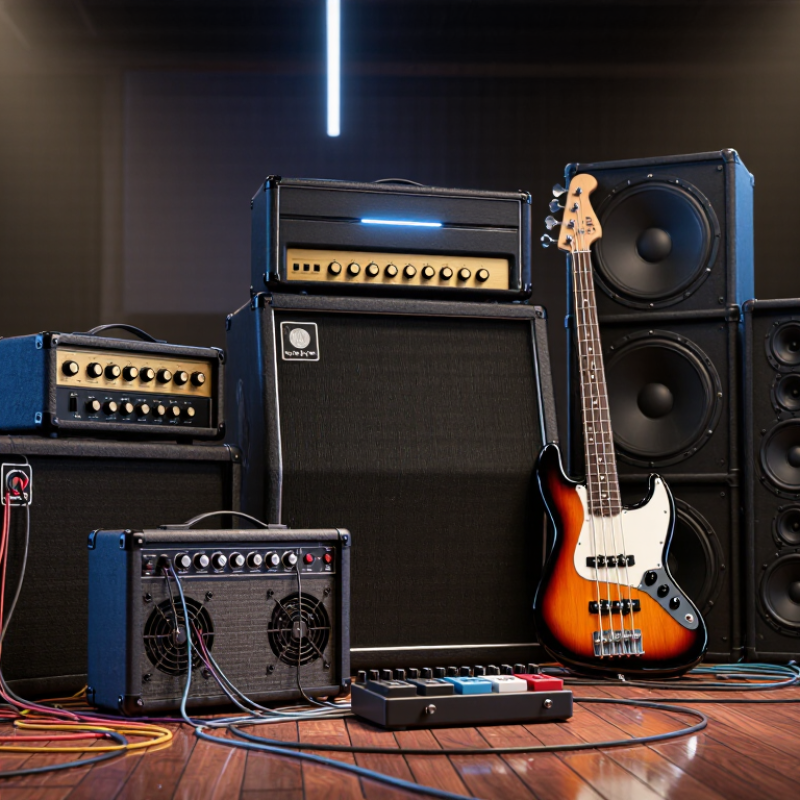
A solid-state bass amplifier uses semiconductor devices, such as transistors, to amplify an instrument’s signal. It does not rely on vacuum tubes in its amplification stage. The label describes the circuit, not the sound: warmth, punch, and clarity also depend on equalization, speaker design, and playing dynamics. The difference is practical. A transistor-based circuit can be compact and handle repeated use without tube replacement. Still, the term alone cannot tell you how an amp will feel under your fingers.
Many current designs use Class-D output stages, which switch power rapidly rather than dissipating as much energy as heat. Audio Engineering Society technical literature commonly reports Class-D amplifier efficiencies around 80–90%, though results vary with load and test conditions. That efficiency can mean less weight and a smaller heatsink—useful when carrying gear up stairs. Not every solid-state amp is Class D, though. And efficient does not automatically mean better. Check the rated output at the speaker’s impedance, then listen for clean headroom at your usual volume. A spec sheet helps, but it won’t capture every room’s low-end rumble. My own caution: “solid state” is a useful description, not a complete buying test.
What Is the Best Solid State Bass Amplifier?
How Solid-State Bass Amplifiers Produce and Shape Sound
A solid-state bass amplifier turns a small pickup signal into enough electrical power to move a speaker cone. Its input stage raises the signal, while tone controls adjust selected frequency ranges. Turn up the low control, and the bass may feel heavier; raise the mids, and finger attacks become clearer. These changes depend on the speaker and room, too. The knob is not the whole story.
A standard four-string bass’s lowest open note is about 41.2 Hz, while its open G string is about 98 Hz. That low range asks the amplifier to deliver clean power without making the speaker struggle. IEC 60268-3:2018 identifies frequency response, distortion, noise, and output power as key amplifier measurements. Those measurements help compare specifications, though they cannot fully predict how an amp feels under the fingers. Small cabinets can sound different from large ones, even at similar settings.
Solid-state circuits use transistors rather than vacuum tubes to amplify the signal. Many designs include equalization and protection circuits that help manage heat and output levels. Class-D output stages can be efficient, but efficiency alone does not guarantee a pleasing tone. Listen at rehearsal volume, not only in a quiet shop. I still find bass controls easy to overuse; a slight boost can become muddy once drums enter.
| Design or Feature | How It Works | Typical Sound or Practical Effect | Best Suited For |
|---|---|---|---|
| Class D power amplifier | Uses high-frequency switching to amplify the signal, then filters the output for the speaker. Many designs combine this with a lightweight power supply. | High power output is possible in a compact, lightweight unit. The sound depends on the full circuit and speaker system, not the class alone. | Players who need a portable amplifier for rehearsals, gigs, or frequent transport. |
| Class AB power amplifier | Uses output devices that operate through more of the signal cycle than in Class D, amplifying the signal before it reaches the speaker. | Often heavier than a comparable modern Class D design because of its power stage and cooling requirements. It can deliver clean, high-volume bass. | Players who prefer a traditional amplifier format and do not mind additional weight. |
| Preamp and input stage | Raises the instrument signal and provides the first stages of tone control. Input sensitivity and gain settings determine how strongly the circuit is driven. | Sets the level and character of the signal sent to the power amplifier. Excessive gain can cause distortion or clipping. | Matching the amplifier to different bass output levels and setting a clean or driven input sound. |
| Three-band EQ | Provides controls for low, middle, and high frequency ranges. The center frequencies and bandwidth vary by design. | Can add low-frequency weight, adjust note definition through the mids, or change pick and string brightness. | Quick tone shaping for different instruments, rooms, and musical styles. |
| Graphic or semi-parametric EQ | Offers more frequency-specific control than a basic three-band EQ; a semi-parametric control may also let the player select a midrange frequency. | Helps target a particular frequency area, such as reducing room boom or improving note clarity in a mix. | Players who need precise adjustments for live venues or recording. |
| Compressor or limiter | Reduces the level of signal peaks once they pass a set threshold. A limiter typically applies stronger peak control. | Can even out playing dynamics and help prevent sudden peaks from overloading later stages. Heavy compression can reduce dynamic contrast. | Controlling uneven peaks or maintaining a steadier level onstage. |
| Overdrive or clipping circuit | Creates distortion by driving a circuit beyond its clean operating range or by adding a dedicated clipping stage. | Adds harmonic content and sustain. The result may range from subtle grit to pronounced distortion. | Players seeking a more aggressive sound; a clean blend can preserve some of the original low end. |
| Speaker cabinet and speaker sensitivity | Convert the amplifier’s electrical output into sound. Cabinet design, speaker size, speaker count, and sensitivity all affect the result. | Strongly influences perceived volume, low-frequency extension, and projection. Amplifier wattage alone does not determine how loud a setup will sound. | Choosing a complete rig that suits the room, desired volume, and available transport space. |
| Choosing the “best” option | Compare clean power at the cabinet’s supported impedance, tone controls, connectivity, protection features, weight, and intended use. | There is no single best design for every player. A suitable cabinet and enough clean headroom are as important as amplifier topology. | Choose a lightweight Class D model for portability, or prioritize specific EQ, connectivity, and playing needs over topology alone. |
Note: Specifications and audible results vary by design, settings, bass, cabinet, and room. Solid-state describes the amplifier’s electronic devices; Class D and Class AB describe power-amplifier operating methods.
A solid-state bass amplifier should provide clean headroom without becoming difficult to carry. Compare its power rating with the speaker cabinet’s impedance and your usual playing volume. A rating alone cannot predict how loud or clear an amp will sound in a room. For rehearsals, listen for notes that remain defined when the drummer gets louder. Check the cabinet connection requirements before buying. Keep it practical.
Tone controls matter most when they solve a real problem. A useful EQ should let you reduce muddy low mids or bring out note attack without making the sound harsh. A direct output is valuable for recording or sending bass to a mixing desk; check whether its level and signal routing suit your setup. An effects loop can help when you use external pedals, but it is not essential for every player. Also compare weight, cooling noise, and protective features. Fan noise may seem minor in a shop, then become distracting in a quiet room. There is no perfect feature list. I would prioritize reliability and clear sound over extra controls, though that preference can change with the venue and cabinet.
What Is the Best Solid State Bass Amplifier?
The best solid state bass amplifier is the one that suits your rooms, volume, and playing style. Start by considering where you play most often. A small practice space rarely needs the same output as a loud rehearsal room. Live shows may call for extra headroom, especially when drums and guitars get forceful. Loud rooms matter.
Check the amplifier’s continuous power rating and the speaker cabinet’s impedance. The cabinet must be compatible with the amplifier’s minimum load; otherwise, you risk poor performance or damage. More watts can provide useful clean volume, but they do not automatically create better tone. For home practice, manageable volume and a headphone output may matter more. For rehearsals, listen for clear low notes that remain defined when you play hard.
Your playing style should guide the remaining choices. Fingerstyle players may prefer a rounded, even response, while players using a pick may want sharper attack. Try your own bass through the amp, not just a shop instrument. Bring the cabinet you plan to use, if possible, and test at realistic volume. Notice whether the low end stays tight and whether the controls are easy to adjust mid-song. It is easy to focus on features and overlook comfort. I would still leave room for doubt: a tone that sounds huge alone may disappear in a full band.
Choosing the best solid-state bass amplifier starts with your actual playing situation, not the largest power rating. Consider where you play, how loudly the drums are played, and whether you need to carry the amp yourself. For a small room, a powerful cabinet may be awkward and unnecessary. That matters. For louder rehearsals, look for enough clean headroom to keep low notes clear when the band gets busy.
Check that the amplifier’s minimum speaker impedance matches your cabinet. An incompatible load can cause problems, so confirm the figures in the manuals. If you play a five-string bass, test the lowest notes at realistic volume; some setups sound full at home but lose definition in a crowded room. Bring your own bass when possible. A quick store test cannot recreate every stage, but it can reveal harsh highs, muddy lows, or controls that feel fiddly.
Useful features depend on your routine. A balanced direct output helps connect to a mixing desk, while an effects loop matters only if your signal chain needs one. Pay attention to weight, handle placement, fan noise, and how quickly the EQ responds. These details seem minor until a late load-out. There is no perfect choice: a lighter amp may offer less headroom, and a simple control panel may lack fine adjustment. Decide which compromise you can live with, then compare candidates at the volume you expect to use.
It uses semiconductor devices, such as transistors, to amplify the instrument signal. It does not use vacuum tubes in its amplification stage.
No. Equalization, speaker design, and playing dynamics also shape warmth, punch, and clarity. The label alone says little about feel.
Many use Class-D output stages, which can waste less energy as heat. That may mean a smaller heatsink and easier trips up stairs.
Technical reports commonly give that range, but results vary with load and test conditions. Efficient does not automatically mean better.
Check the rating at your cabinet’s impedance, then listen at your usual volume. A spec sheet cannot capture every room’s low-end rumble.
Play while the drummer gets louder. Notes should remain defined, not blur into the room. That test matters.
Look for EQ that can reduce muddy low mids or sharpen note attack without harshness. More controls are not always helpful.
A direct output can send bass to a recorder or mixing desk; check its level and routing. An effects loop helps with some external pedals, but not everyone needs one.
Compare weight, cooling noise, and protective features. Fan noise may be easy to miss in a shop, then distracting in a quiet room. I may give reliability too much weight, but it is worth considering.
A Solid State Bass Amplifier uses electronic components to strengthen a bass guitar’s signal, offering a practical balance of clarity, reliability, and ease of use. Its circuitry shapes the sound by controlling volume, tone, and response, helping players create anything from a clean, defined sound to a fuller, more pronounced one. Understanding how these controls affect the signal makes it easier to choose an amplifier that suits different musical styles and playing environments.
When comparing amplifiers, consider output power, speaker configuration, tone controls, available connections, portability, and ease of operation. The right choice depends on where and how you play: a compact setup may suit home practice, while rehearsals or performances may call for greater volume and flexibility. Set a realistic budget, identify the features you will actually use, and, when possible, listen to the amplifier with your instrument. The best option is the one that delivers the sound, practicality, and performance you need.